Structured 11+ English exam preparation
Thoughtful English lessons for learners aged 9 - 11 years old, shaped around specific requirements of an independent school that the child is aiming to get in. Support can include reading comprehension, writing skills, expanding vocabulary and grammar.
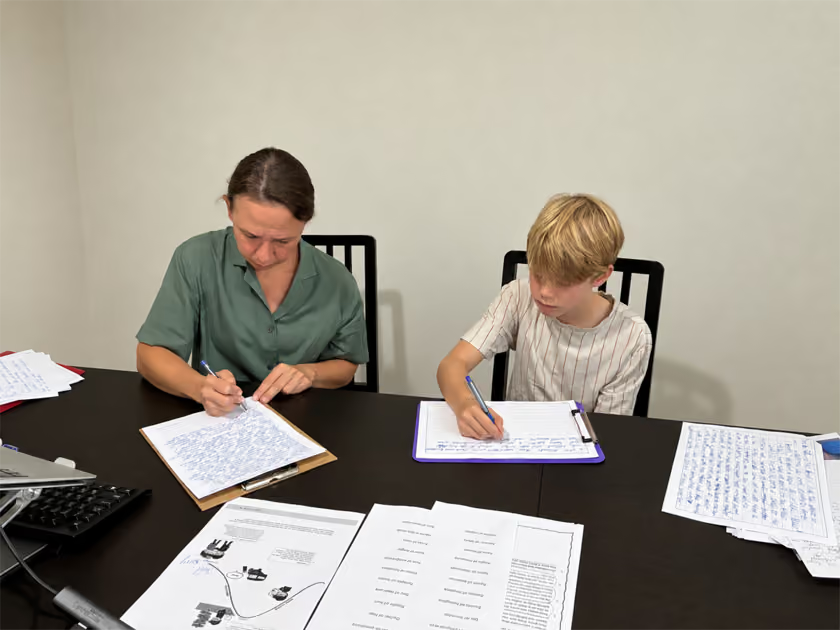
English support shaped around the child's starting point and future aspirations
Are you aiming for your child to sit for the 11+ English entrance examination at an independent school? Would you like the child to prepare for it in a structured and purposeful way? In these lessons, the learner will be working on reading comprehension and writing skills so that they have the best chance to succeed in their exam.
Depending on the school you are aiming to get into, the 11+ English entrance examination may include reading comprehension, writing, grammar, vocabulary, spelling, and punctuation tasks. Once you get in touch with Arina and specify the school you are aiming at, she will choose a lesson sequence that will prepare your child for that particular school.
For parents looking for careful, structured 11+ English support
This is suitable for any of these situations:
- your child is in Year 5 and started preparing for 11+
- your child is in Year 6 and aiming to sit for the exam within the 1 - 5 months period
- your child is preparing to secure a place at an independent school in the UK
- your child is aiming to get into Year 7 at the Perse School Cambridge
- for children who do not necessarily aim to get into an independent school, but would like to challenge themselves when they are in Year 5 and Year 6
Writing and reading taught through structured activities
In order to respond to a reading passage in the 11+ English exam, your child will need a range of skills and abilities. First, rich vocabulary, including rare words that are not used in everyday conversation but mostly found in literary writing. This is something your child will be working on in the lessons. In the reading comprehension section of the exam, the child may be asked to show their understanding of rare vocabulary. Second, genre features. These are conventions that writers follow when they work on a specific text type. These may include broad categories, such as fiction and non-fiction, and more specific categories, such as personal narrative, biography, science-fiction, diary entry, newspaper article, descriptive text, fantasy, or adventure. Understanding how to recognise genre features will help the child understand and appreciate the text better and may improve the speed with which the child absorbs the information in a given text. Third, literary devices. The child will learn about a range of them, including metaphor, simile, imagery and personification. It will help the child recognise these devices in a text and understand how they help shape the meaning.
Some 11+ English exams include a writing section. In order to write imaginatively and cohesively while demonstrating a great command of the language expected for the 11+ entry, the child will go through all essential stages of writing process with Arina. These stages include brainstorming ideas both orally and in writing, writing up a draft where ideas matter more than form, and refining the quality of writing so that the reader can appreciate these ideas. Several micro-skills will be involved too. For example, finding suitable language, which may include literary devices, rare vocabulary or show-don’t-tell techniques. Also, grammatical accuracy and range are important for an engaging piece of writing. Plot development and characterisation combined with descriptive writing may be practised too.
The learner will use their background knowledge to work on their writing, as well as learning new things about the world, society and personality traits. Your child will work in collaboration with the teacher to develop writing that is filled with excitement, a sense of discovery and pride.
Reading comprehension
Understanding author ideas, and learning about the world. Using a range of vocabulary to discuss ideas in passages.
Writing
Going through essential stages of a writing process: brainstorming, creating a draft and fine-tuning. Practising descriptive and narrative writing.
Vocabulary
Using new vocabulary in writing and recognising it in reading passages.
Literary devices
Learning to recognise such devices as metaphors, personifications and imagery. Practising using these devices in stories.
Grammar
Practising grammatical range and accuracy, including learning how to use simple, compound and complex sentences to communicate ideas clearly.
Genre features
Language features used in fiction and non-fiction, such as dialogue, characterisation, plot, tension, and facts.
English support grounded in teaching experience and child development
Arina successfully prepared learners for 11+ (Year 7) English examination entry to independent schools, including the Perse School Cambridge, not through tedious exercises that do not make sense to the child,but through collaboration, imaginative exchange, active listening and taking every opportunity to learn from each other.
She started preparing Year 5 and Year 6 learners for the 11+English exam in August 2022. Since then, Arina has been working with learners from London, Cambridge and Birmingham online and face-to-face. Her top-down, context-based approach has been appreciated by both parents and learners. In her lessons, she prioritises meaning making and exchanging ideas about the world,society and individual behaviour. This meaning-first approach allows children to use their imagination in writing and absorb ideas that were written by others. Every lesson is contextually grounded and other sub-skills, such as sentence structure and punctuation, are practised in relation to the established context.
The meaning behind texts always stays the most important driver of the exam preparation process both in reading comprehension and writing.Such top-down approach is crucial, because without the focus on meaning,meta-language, such as “metaphors” and “complex sentences” used out of context are not conducive for learning. Language features need to emerge from the meaning behind a given text. This approach stands her apart from some other offers available for the 11+ preparation, in which micro-skills are practised first,and meaning making practised last. From Arina’s experience, this approach can be confusing and disorienting for the learner. However, developing ideas and understanding other people’s ideas is natural process that glues all other important English language aspects together.
Education
Arina holds Bachelor of Fine Arts, Graduate Diploma in Education (Secondary) and Diploma in Teaching English to Speakers of Other Languages. Throughout her tertiary degrees, she practised expressing her ideas visually and in writing, designing learning programmes, scopes and sequences, and assessments.
Entrance exam preparation
Preparing learners for 11+ English exams since 2022. Track record of learners securing a place in the Perse School Cambridge.
Educational psychology and learning theories
Vigorously studied and applied in practice empirically-proven theories of how children learn, including Vygotsky's socio-cultural theory, Bandura's self-efficacy theory, and cognitive-processing theories.
Methodology
During her two post-graduate degrees, she studied teaching methodologies extensively, and in her teaching practice she actively uses a range of teaching methods to find what works best for each child. Teaching methods include visual analysis, genre-based and text-based methods.
Primary and secondary teaching experience
Worked as a teacher in primary and secondary schools, and understand the importance of a smooth transition between these two stages.
Safeguarding
DBS Update Service is held. Arina understands and complies with safeguarding principles.
Parents value the structure, feedback, and care
Comments from parents whose children worked with Arina on 11+ English exam preparation or advanced Year 5 - 6 studies.
"Jamie has been offered a place at the Perse.
Thank you for your help with him I am certain that it really helped him secure a place."
“Noah secured a place. Thanks a lot for your help with Noah.”
“Arina is a great tutor. She understands how to match teaching skills with ability of the kid, and he grasps it all quickly. For my son, she always makes it interesting to learn which generates curiosity in my son to learn and enjoy the work he does.”